A time crystal sounds like a world saving artifact from a Doctor Who episode, but is it in fact real?
Nobel laureate Frank Wilczek, may have been a Doctor Who fan, proposed the concept of a ‘time crystal’ in a 2012 paper (Phys. Rev. Lett. 109 160401 2012). Interestingly his concept of a time crystal was disputed in 2013 and finally refuted in 2015 (Phys. Rev. Lett. 114 251603 2015). Scientists came to the conclusion that it could not exist by itself in a self-sustained form.
So what is the ‘time crystal’ that scientists claim to have found in (Nature 543 217 2017), and how may they come to impact our lives?
Crystals are stable structures made of periodically repeating atoms. Periodically repeating LEGO connectors can be seen in the image of Figure 1. In the case of crystals like amethyst, diamond and iron, a specific configuration of atoms are being repeated. Figure 2, shows the configuration of carbon atoms that are then repeated to create a diamond.

Figure 2: Diamond

A time crystal is then a crystal where instead of the periodicity being measured through distance, it is measured by time. At every time ‘t’ an atom returns to the same position; like a GIF! A GIF is a small video clip played over and over again in a loop. Figure 3 is an example. It is of a penguin being knocked into the ocean, where at the end of each loop the penguin returns to the same position on the ice.
Figure 3: GIF of a Penguin being knocked into the water

Recently, scientists found that the model of the time crystal that Frank Wilczek proposed back in 2012 could exist, but only if they are not self-sustained (Phys. Rev. Lett. 118 030401 2017). Meaning a system with an external driving force, for example repeatedly hitting a crystal with a laser.
A model of this new not self-sustained time crystal was proposed in 2016 by Norman Yoa and his colleagues (Physics 10, 5 2017), Figure 4. Their model uses periodically repeating magnets, rather than atoms . In Figure 4 the magnets are denoted as arrows, where the arrows give the direction of the magnetic field of each magnet. At every time of length ‘T’ the system is hit by a laser, causing the magnets to point in alternating up and down directions. This in turn causes the system to return to the same configuration every time period ‘2T’. As the system has inherent disorder it can not organize by itself, so as long as the laser is applied periodically the crystal will return to the same configuration every ‘2T’, forever! Therefore creating a new form of a time crystal.
Figure 3: Physics 10, 5 2017

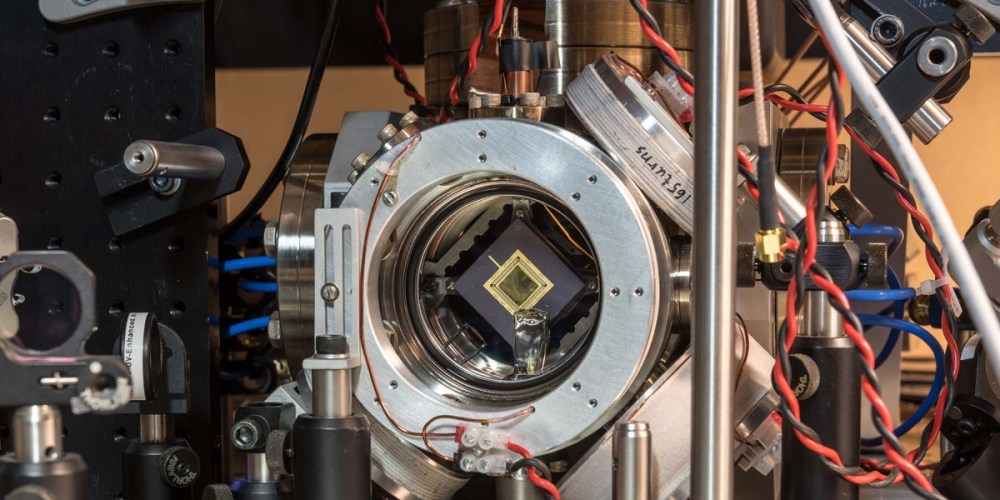
Last year scientists at the University of Maryland published an article proving that these new time crystals really exist. They were found by trapping ytterbium ions in ion traps, then hitting them with a laser. Ion traps are machines where atoms can be very precisely controlled by a complex system of magnets and electric fields, shown in Figure 5. Ion traps are ideal for investing time crystals as they are a very versatile and sensitive investigative platform.
Figure 4: Ion Trap Machinery
Assistant Professor Phil Richerme has 14 years of experience investigating quantum materials with ion traps and he wrote ‘Viewpoint: How to Create a Time Crystal’ (Physics 10, 5 2017). He states that time crystals will be ‘an active and interesting sub-field of research’, and that time crystals could have a ‘large potential’ for becoming the hard drives (data storage) for quantum computers. The reason being that the fixed ‘2T’ periodicity of time crystals allows them to be very robust to other unwanted interferences. Time crystals would also be perfect as hard drives as they last forever (with the continuous application of the laser) . That said, Dr. Richerme surmises that time crystals need to solve a ‘major-pressing technological problem for society’ to really gain the amount of funding and popularity as some of the big topics in research.
It is good to remember that feelings at the start of an investigation do not always reflect the eventual success of the finding. J.J Thompson discovered the electron using cathode ray tubes, famously said ‘The electron: may it never be of any use to anyone!’ (Proceedings of the Royal Institution of Great Britain 35 251 1951); little did he know, at the time, what a force the electron would become. Electrons are now used in every electrical device in your home, charging your phone, turning your lights on, and powering your TV. They are the building blocks of our technological society!
Only time will tell what the future holds for time crystals, in the interim, there is always Doctor Who!

 Nicole Reynolds