The Higgs boson has now been observed interacting with a top quark, the heaviest known fundamental particle. This is the strongest interaction with the Higgs boson to date. The observation was of the simplest form of the top quark, antitop quark and Higgs boson (ttH) production process, called the tree-level process. Observation of this production process is the first direct proof that top quarks gain their mass from their interaction with the Higgs field. This observation of the tree-level ttH production process has also allowed scientists to determine if there are any contributions from new physics, aka physics outside of the commonly accepted Standard Model (link), in the ttH production process.
What are quarks? Quarks are the fundamental building blocks of matter. The other fundamental building blocks are Leptons and the four fundamental forces; all of which are outlined by the Standard Model. The Standard Model is the current understanding of particle physics that was developed in the 1970s. It explains the interactions between the fundamental particles through the fundamental forces . Figure 1 shows the fundamental particles that make up the Standard Model. The Higgs boson that was discovered back in 2012 is now also widely accepted to be part of the fundamental particles.
Figure 1: Standard Model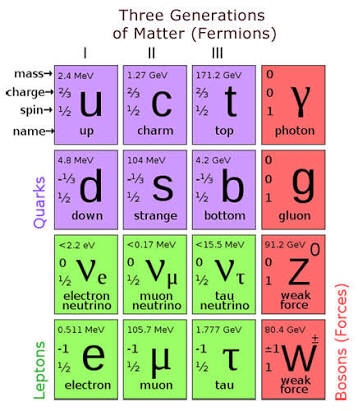
Gavin Salam from the Theoretical physics department at CERN, Geneva Switzerland, says that the Higgs bosons are excitations of the Higgs field, ‘like waves in the Higgs field’.
Figure 2 shows one example of the three-level ttH production process in the form of the famous Feynman Diagram. The vertical axis represents time and the horizontal space. q stands for quark, t for top quark and H for Higgs boson. The letters with dashes above then denotes antiparticles. That move in the opposite direction in space to their normal particle counterparts. The diagram shows that two quarks collide, emit a gluon (curvy line), then the gluon is absorbed by a top and an antitop quark who then emit a Higgs boson.
Figure 2: Tree-Level Feynman Diagram of ttH Production Process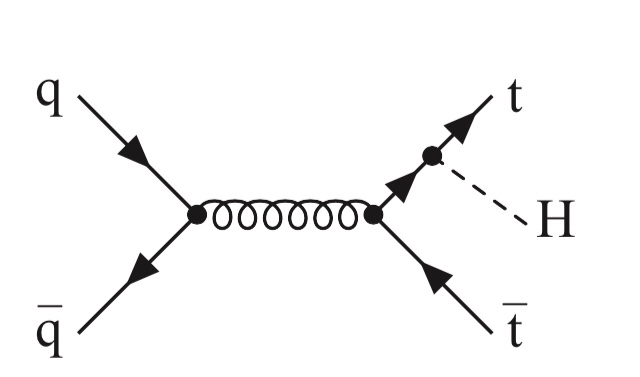
The benefit of investing the tree-level ( simplist) ttH production process is that it is well understood theoretically within the Standard Model. Therefore, if any deviations occur we know it is from new, unknown physics!
The Standard Model predicts that the interaction of a quark and the Higgs field automatically generates the mass of that quark. Therefore the mass of a quark is directly related the the strength of its interaction with the Higgs field. Further Dr. Gavin Salam states that ‘anything that interacts with the Higgs field can also induce an excitation of the Higgs field.’ An excitation of the Higgs field is a Higgs boson.
Thus by measuring the production process of a top quark and antitop quark emitting a Higgs boson, we are directly observing the interaction of the top quark and the Higgs field, and it’s subsequent obtaining of mass.
The ttH production process was measured on the CMS and ATLAS detectors at the LHC. The CMS and ATLAS detectors are shown in Figure 3 a) and b) respectively. They measure the speed, direction, and energy of the particles emitted from the proton-proton collision at the Large Hadron Collider ( LHC) at CERN. The CMS detector is built around a large solenoid magnet that generates a magnetic field 100,000 times that of the earth’s magnetic field. ATLAS is the world’s largest volume detector ever build at 7,000 tones, that’s equivalent to 2,300 small cars!
Figure 3:
A) CMS
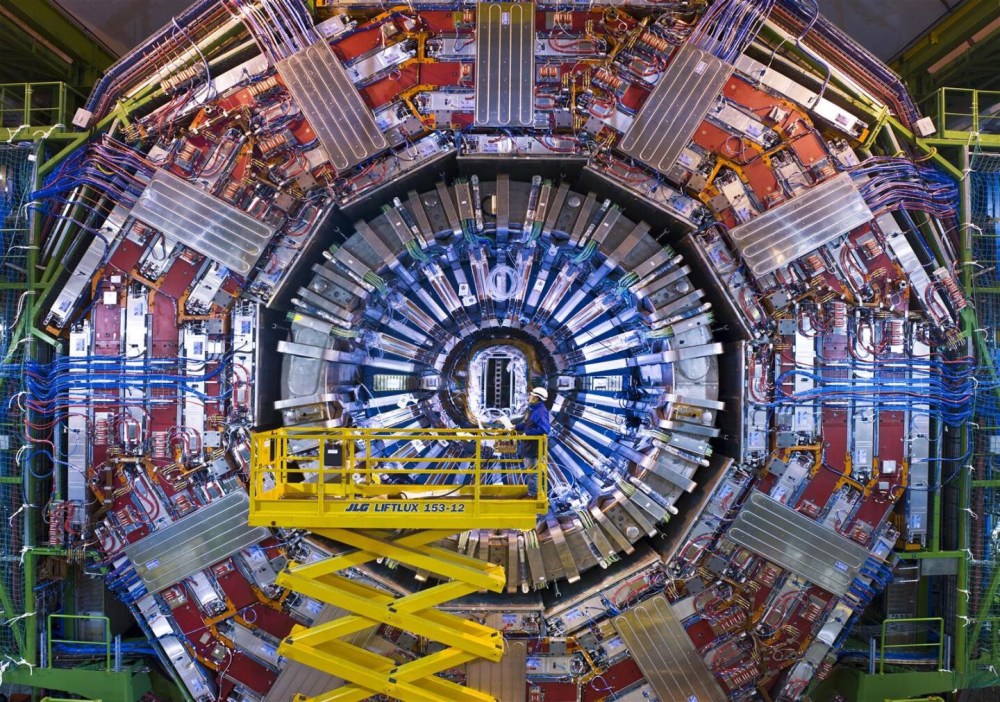
B) Atlas
The top quark is the heaviest quark, therefore it has the strongest interaction with the Higgs field, where it gets its mass from. According to the Standard Model theory only ‘1 Higgs boson for every 1600 of the LHC collisions [proton-proton] that produce a top and an antitop’ quark, states Dr. Gavin Salam. So it is quite an unlikely event to occur, 1/1600!
Scientists considered the five most likely Higgs boson decay channels, to W bosons, Z bosons, photons, tau leptons, and bottom quarks ( see Figure 1 for details). At three different proton-proton collision energies. Scientists have concluded that the rate of the ttH production process is in very good agreement to the Standard Model within 1 standard deviation. Our search for new unknown physics not explained by the Standard Model continues!
One such search is for direct proof of the lighter particles interaction with the Higgs field. Muons have a mass just over a thousand times smaller than the mass of the top quark. Therefore their interaction with the Higgs field will be correspondingly much weaker. To remedy this, a new LHC called the High Luminosity (HL) LHC is already under construction since the 15 th of June 2018. It is expected to increase the luminosity, which is proportional to the number of proton-proton collisions by a factor of 10! According to the CERN HL-LHC webpage that is expected to increase the number of Higgs bosons produced from 3 million at the LHC in 2017, to 15 million at the new HL-LHC when it is finished in 2026.

 Nicole Reynolds